
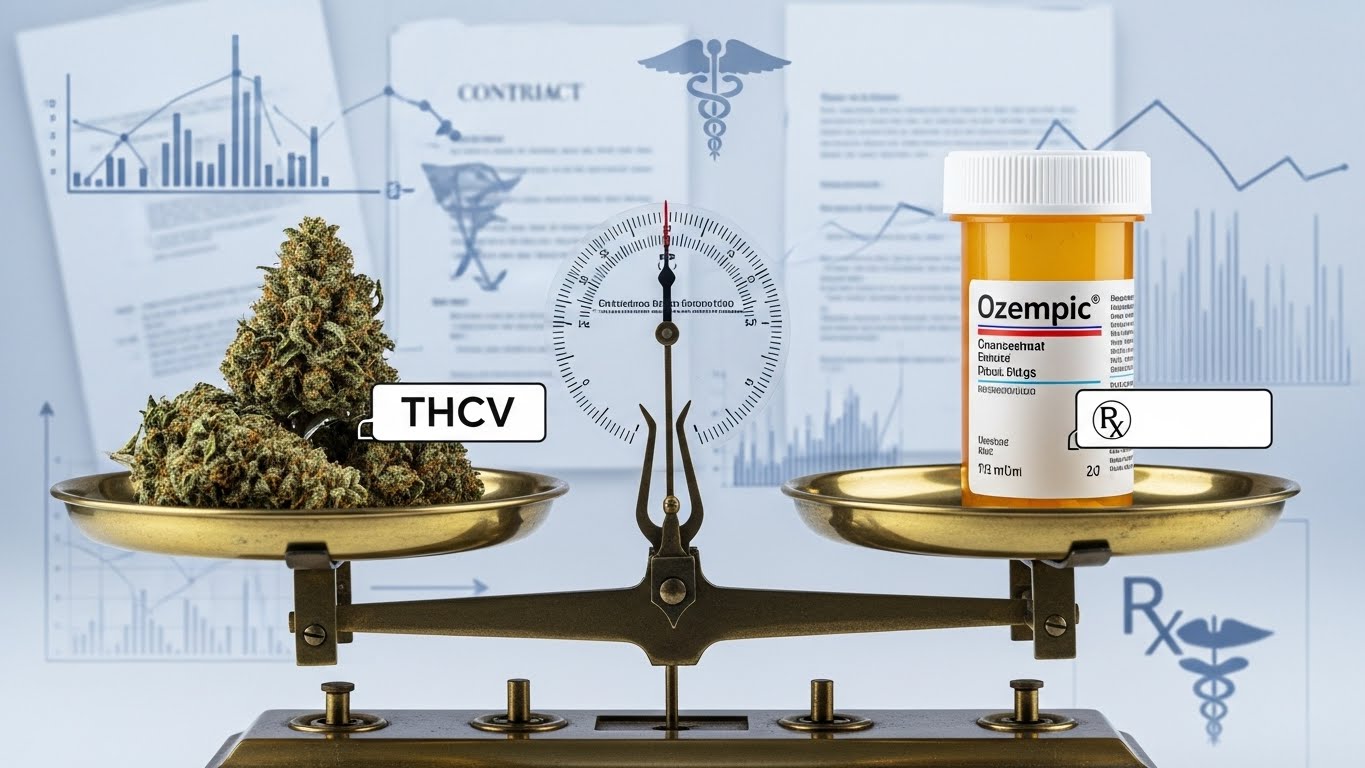
Move over Semaglutide. There’s a new molecule in town that doesn’t require a needle, but the science is way more complex than the marketing hype suggests.
Let’s be real: we are living in the era of the "quick fix." If you’ve been anywhere near the internet in the last year, you’ve heard of Ozempic. The world is obsessed with GLP-1 agonists. But as much as those shots are changing lives, they’re also expensive, hard to find, and—let’s face it—not everyone wants to jab themselves with a needle every week just to stop the cravings for a late-night burger.
Enter Tetrahydrocannabivarin (THCV). The street is calling it "Diet Weed" or "Nature’s Ozempic." It’s being marketed as the holy grail of cannabinoids—the one that actually suppresses your appetite instead of giving you the munchies. But at BluntTalkzz, we don’t just buy into the hype. We look at the molecular blueprints.
Is it really the natural answer to metabolic syndrome, or just another Green Rush marketing scheme? To find out, we have to look at the 2025 clinical data, the "Rimonabant disaster" of the past, and why minor cannabinoids are the future of the industry. Strap in—this is the intellectual deep dive you’ve been waiting for.
1. The Metabolic War: GLP-1 vs. The ECS
First, let’s clear the air. Calling THCV "Nature’s Ozempic" is a bit of a stretch pharmacologically. Ozempic (semaglutide) works by mimicking a hormone called GLP-1. It tells your pancreas to make more insulin, slows down your stomach so you stay full longer, and hits your brain to kill the appetite. It’s effective, but it’s a brute-force approach.
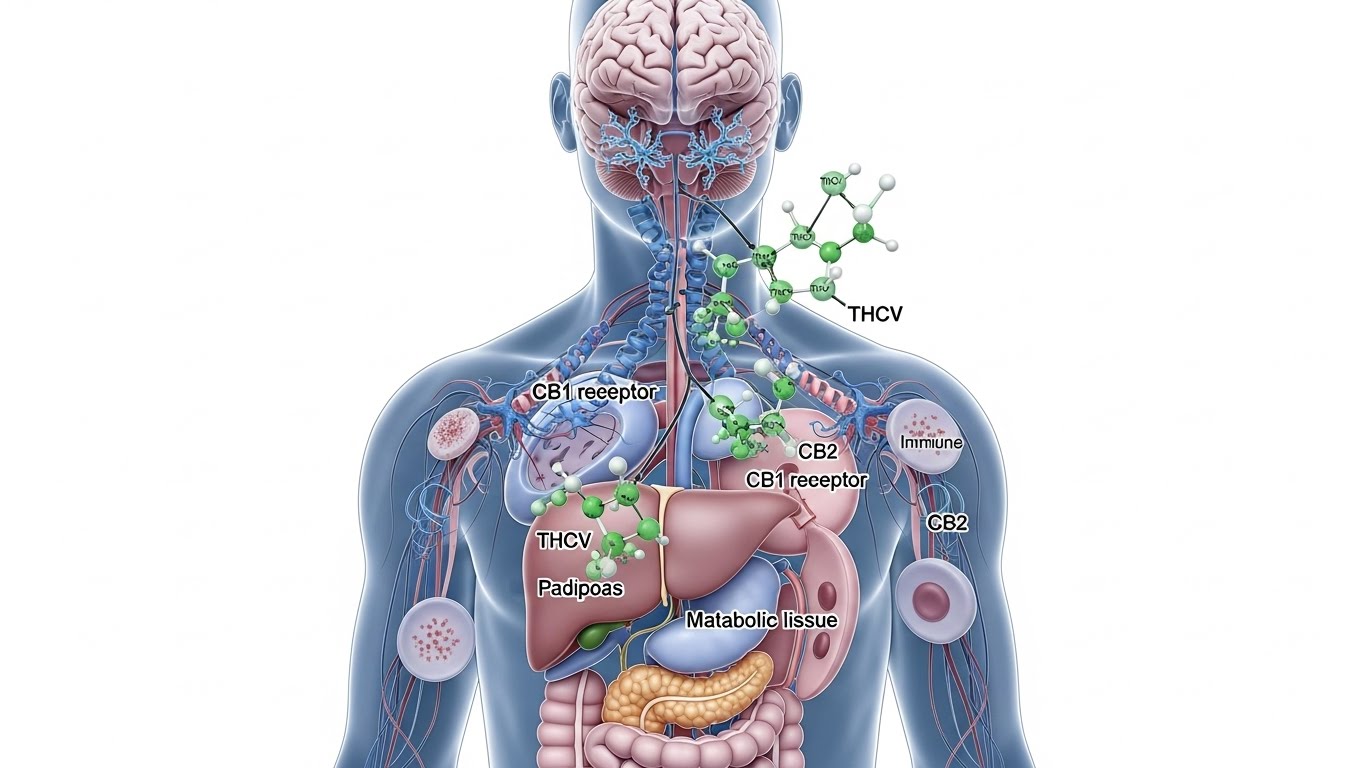
THCV operates on an entirely different frequency. It targets the Endocannabinoid System (ECS). Specifically, it interacts with the CB1 and CB2 receptors.
"If Ozempic is a physical roadblock that stops you from eating, THCV is more like a volume knob that turns down the noise of hunger."
In your brain, the CB1 receptor is the "hunger button." When THC (the stuff that gets you high) hits that button, it’s like a five-alarm fire for food—hence the munchies. THCV, at therapeutic doses, is a neutral antagonist at the CB1 receptor. It sits on the button so nothing else can push it. It blocks the reward drive that makes you reach for that third slice of pizza.
2. The "Sports Car" Pharmacology: Why Dosage is Everything
THCV is often called the "sports car" of cannabinoids because it’s fast, powerful, but you have to know how to drive it. Unlike CBD, which is pretty chill regardless of the dose, THCV has a biphasic dose-response curve.
Don't let the science talk bore you—this part is crucial. Biphasic means it does different things at different amounts:
- Low to Moderate Doses: It blocks the CB1 receptor. This is where the magic happens—appetite suppression, metabolic upregulation, and increased energy.
- High Doses: It flips the script. At high enough concentrations, it can start to activate the CB1 receptor, potentially giving you a clear-headed "high" and actually negating the weight loss benefits.
This is why those cheap gas-station THCV gummies usually don't work. If the dosage is off, or if it's mixed with too much Delta-9 THC, you're just going to end up high and hungry again. The cannabis honeymoon phase might be over for some, but for those chasing metabolic health, it’s all about precision.
Table 1: The Heavyweight Matchup — Ozempic vs. THCV
| Feature | GLP-1 Agonists (Ozempic) | THCV (Nature’s Option) |
|---|---|---|
| Primary Target | GLP-1 Hormone Receptors | CB1 & CB2 (Cannabinoid) |
| Method | Incretin Mimicry | Neutral Antagonism |
| Brain Effect | Satiety (Feeling Full) | Reduced Craving/Reward |
| Administration | Weekly Injection | Oral/Inhalation |
| Typical Cost | $1,000+ per month | $50 - $150 per month |

3. Clinical Breakthroughs: The 2025 NeX Therapeutics Study
For years, skeptics pointed to an old 2016 study by GW Pharmaceuticals that showed THCV helped with blood sugar but didn't actually cause weight loss. But in early 2025, a landmark study published by NeX Therapeutics (Smith et al.) flipped the script.
Why did the 2025 study succeed where 2016 failed? One word: Bioavailability.
The 2016 study used standard capsules. Cannabinoids are famously bad at getting through the gut. By the time that capsule hits your liver, most of the THCV is destroyed. The 2025 study used mucoadhesive strips (like breath strips) that dissolve on your gums. This bypassed the "first-pass metabolism" and sent the THCV straight into the bloodstream.
The Results?
- Participants lost an average of 4.1 kg (roughly 9 lbs) in 90 days.
- They saw a significant reduction in waist circumference and systolic blood pressure.
- Serum lipids (the bad fats in your blood) dropped significantly.
This shows that THCV isn't just a gimmick—it’s a delivery problem. If you’re just eating gummies, you’re basically wasting your money. You need a delivery system that respects the molecule.
4. The Safety Paradox: Avoiding the Rimonabant Disaster
If blocking the CB1 receptor causes weight loss, why didn't we do this years ago? Well, Big Pharma tried. In the mid-2000s, they released a drug called Rimonabant. It worked for weight loss, but it was a disaster.
Rimonabant was an inverse agonist. It didn't just block the CB1 receptor; it turned it off completely. Since the ECS helps regulate your mood, Rimonabant crashed the system, leading to severe depression and suicidal thoughts. It was pulled from the market globally in 2008.
THCV is different. It is a neutral antagonist. It doesn't crash the system; it just occupies the space so you don't get the "food reward" signal. Think of Rimonabant as turning off the lights in your house, while THCV is just pulling the blinds. You still have your mood, but you aren't staring at the fridge all night.
5. Durban Poison and the "Landrace" Connection
If you’re looking for THCV in the wild, you have to look toward Africa. Pure "Landrace" Sativa strains like Durban Poison are the natural home of THCV.
Most modern weed has been bred for maximum THC and big, heavy buds. In that process, we lost the rare cannabinoids. But Durban Poison is famous for that "coffee-like" energy. That’s the THCV talking. It works with terpenes like Terpinolene to provide a sharp, focused energy that's the exact opposite of the couch-lock you get from an Indica. This is why it's becoming a staple in the future of health and fitness.
Table 2: Where the THCV Lives — Top Genetic Sources
| Strain / Source | Typical THCV Range | Key Characteristics |
|---|---|---|
| Durban Poison | 0.5% - 1.5% | Original landrace; energizing; focus-heavy. |
| Doug’s Varin | 10% - 15% | Rare outlier; 1:1 THCV to THC ratio. |
| Pink Boost Goddess | 4% - 6% | Award-winning floral terpene profile. |
| CBD Conversion | 99% Isolate | Semi-synthetic; high purity but controversial. |
6. The 2025 Regulatory Cliff: Is Your Supply Legal?
Here is the street-wise truth: the government is trying to shut the door on the "hemp loophole."
In late 2025, federal amendments to the Farm Bill introduced "Total THC" caps. This means if your THCV product has even trace amounts of Delta-9 THC (which most natural extracts do), it could be classified as a Schedule I substance. Furthermore, the new laws are cracking down on synthesized cannabinoids.
Most of the THCV on the market right now is made in a lab by converting CBD into THCV. Under the 2025 rules, these "chemically modified" cannabinoids are in the crosshairs. This means that high-quality, naturally extracted THCV is about to become more expensive and harder to find. If you find a bargain-basement THCV product, it's either fake or about to be illegal.
7. Conclusion: The BluntTalkzz Verdict
So, is THCV "Nature’s Ozempic"?
In short: No, but it’s a legitimate metabolic tool.
It doesn't work as fast as a pharmaceutical injection, and it won't fix a bad diet overnight. But the science is clear: as a neutral CB1 antagonist, THCV helps reset your body's reward signaling. It helps you "unlearn" the drive to overeat.
If you're going to use it, remember the rules:
- Delivery Matters: Avoid standard gummies or capsules. Look for sublingual strips or high-quality tinctures.
- Don't Overdose: Remember the biphasic curve. More is not better; it might just get you high and negate the weight loss.
- Source Carefully: With the 2025 regulatory shifts, only natural extracts from reputable landrace genetics will survive the crackdown.
THCV is for the intentional user—someone who wants to manage their health without losing their mind to Big Pharma costs. It's science, it's nature, and if used correctly, it’s a game-changer.