New Jersey's Cannabis Divide: Why the Grey Market Is Still Beating Legal Weed
The state wants your tax dollars, but consumers are voting with their wallets.
By The Blunttalkzz Investigative Team
Since recreational cannabis became legal in New Jersey, there has been a long standing debate about the legal cannabis market vs the legacy black market. Many people prefer the legal market because it is safe and well regulated, while others prefer the black market for the cheaper prices and legacy growers that refuse to bring their skills corporate.
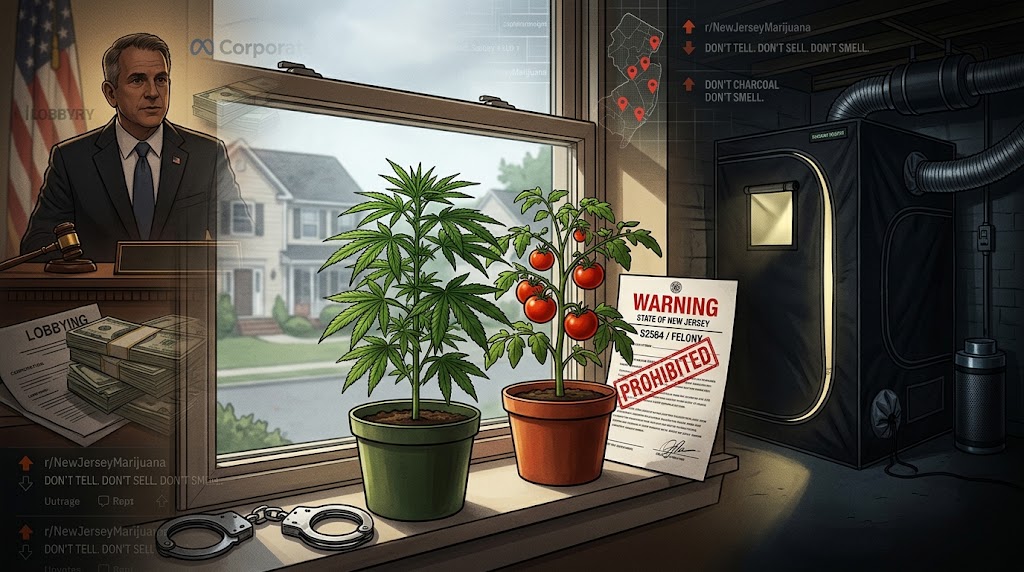
In Jersey this debate grows deeper because of the draconian ban on home growing. Forcing medical patients to the black market, for higher amounts and cheaper prices. New Jersey seems to care more about their tax revenue than the safety of their own citizens. It is literally a gut punch for many smokers that want to grow rare pheno-types, but are forced to either break the law, or go legal!
In this article, Blunttalkzz will breakdown the consequences of NJ’s over regulated weed market, and how more cannabis smokers are turning to underground cannabis dealers and delivery services, to get their medicine. Many people just can’t afford the dispensary prices, or for medical patients, the dispensaries just don’t carry what they are looking for.
Here is the central question we have to answer:
If New Jersey has legal cannabis, why are so many consumers still buying from the grey market—and what does that say about the state's legal industry?
Why pay $50 for an eighth at the weed dispo, when you can get a whole OZ for $120, of equal or better quality? This is what is going through the minds of mostly all the smokers in Jersey and states with similar overpriced markets. Mostly everybody has a friend showing off their grey market weed, saying shit like, “Bro I got a whole zip of this for $120.” While you're looking at the eighth you just bought at Bloc for $55, of equal or less quality.
Blunttalkzz did some research on this subject and we are going to break down both markets in detail. We checked the state data, analyzed the economics, hit the streets, and interviewed the community to find out exactly why the "legal" system is pushing its best customers underground.

1. The Economics of the Hustle: Why We're Paying the Highest Prices in the Country
Let’s talk money, because that’s the main reason people are bypassing the legal storefronts. New Jersey is currently functioning in an era of premium, artificially inflated pricing. According to recent market data from firms like Headset and Cannabis Benchmarks, New Jersey has some of the absolute highest weed prices in the nation.
The average retail price for a gram of flower in New Jersey hovers around $14.80. Let that sink in. If you drive to Michigan, that same gram averages $3.80. If you go to Colorado, it's about $5.20. At the register in NJ, an ounce of legal recreational flower will run you between $250 and $320 after taxes. Meanwhile, the exact same volume—often with a better terpene profile—can be copped from a grey market delivery service or "gifting" shop for $120 to $150.
"I’ve gotten an ounce for $100... why the hell would I drive out of my way, wait in a line, and pay almost 5x that for something that’s equal if not worse quality?"
— User on r/newjersey
Why is the legal weed so damn expensive? It's not just inflation; it's by design. The state created an oligopoly. When legalization rolled out, the barrier to entry was so high (requiring millions in capital) that only massive Multi-State Operators (MSOs) could afford to set up shop.
Furthermore, nearly 64% of New Jersey municipalities opted out of allowing cannabis businesses. That created hyper-competition for real estate in the few towns that did allow them, driving up rents. Plus, while the state has handed out over 2,400 licenses, a massive "activation gap" means over 80% of those businesses are stuck in red tape and aren't actually operating. With only a handful of corporate cultivators supplying the entire state, they control the supply, and therefore, they set the price floor. The top dispensaries in North Jersey are doing their best, but they are bound by these wholesale constraints.
| State | Avg. Retail Price per Gram | Market Status |
|---|---|---|
| Michigan | $3.80 | Mature, Oversupplied, Competitive |
| Oregon | $4.20 | Mature, Oversupplied |
| Colorado | $5.20 | Mature, Stabilized |
| New Jersey | $14.80 | Nascent, Supply Constrained, Oligopoly |
2. The Quality Disconnect: The "Lifeless Bud" Phenomenon
If that $300 legal ounce was the best weed you've ever smoked, maybe people would pay it. But it's not. The second biggest reason the grey market is thriving is product quality. There is a deep, pervasive frustration with corporate cannabis among legacy smokers.
When you buy from a massive MSO, you are buying industrial agriculture. To process thousands of pounds of biomass rapidly, these corporations use machine trimmers. Those machines violently agitate the flower, knocking off the trichomes (the frosty crystals holding the THC and terpenes). To pass New Jersey's incredibly strict microbial tests and avoid mold, they often over-dry the flower. Then, because the prices are so high, that over-dried, machine-tumbled bud sits in plastic or mylar packaging in a vault for months.
The result? You crack open a $60 eighth and it smells like hay, crumbles to literal dust in your grinder, and lacks any real flavor. We call this the "Lifeless Bud" phenomenon.
Experienced smokers know the difference between corporate mids and craft cannabis. They want to see the best New Jersey cannabis flower brands pushing for proper curing and hand-trimming, but the current market structure makes that incredibly difficult. The grey market vendor, who often sources small-batch runs from dedicated growers in Maine or local underground cultivators, provides a sticky, aromatic, fresh product that the corporate machine literally cannot replicate at scale.

3. The Felony Plant: How NJ Punishes Medical Patients
This is where New Jersey's laws cross the line from "annoying" to "immoral." New Jersey is the only state in the Northeast with legalized adult-use cannabis that aggressively prosecutes home cultivation.
Let's be perfectly clear: under N.J.S.A. 2C:35-4, growing a single cannabis plant in your basement is classified as a third-degree crime. It carries a mandatory three to five years in state prison and a fine of up to $25,000. It doesn't matter if you are a 21-year-old rec user or a 65-year-old cancer patient. There is no medical carve-out.
For a medical patient who needs a specific, high-dose regimen of a rare phenotype that dispensaries don't carry (because it's not profitable to grow at scale), they are looking at medication costs of up to $1,000 a month. They are effectively priced out of the legal market. Their choices are to go without their medicine, buy from the grey market, or risk a felony by growing a plant in their closet.
"This entire system is broken and was made to be that way to funnel money into the right pockets."
— User on r/NewJerseyMarijuana
Trenton politicians, like Senate President Nick Scutari, have blocked home grow bills for years, citing fears that neighborhoods would turn into "jungles" and that unregulated weed would flood the streets. But the streets already have unregulated weed—because the legal market is too expensive! The home grow ban isn't about public safety; it's a financial mechanism designed to protect the retail revenues of the MSOs. It ensures every consumer remains a captive audience to the corporate oligopoly.
| State | Adult-Use Home Grow? | Plant Limits | Penalty for Non-Compliance |
|---|---|---|---|
| New York | Yes | Max 12 per household | Civil Fines |
| Massachusetts | Yes | Max 12 per household | Civil Fine ($300) |
| Maine | Yes | 3 mature, 12 immature | Varies |
| New Jersey | No | 0 Plants | Felony (3-5 Years in Prison) |
4. Safety Theater: Lab Shopping and Irradiated Weed
The trump card the state always plays is safety. "You have to buy from the dispensary so you know it's tested and safe!" While it is absolutely true that street-level vape carts can be incredibly dangerous (counterfeits, heavy metals, Vitamin E acetate), the legal market's safety narrative regarding flower has massive holes in it.
First, there is the open secret of "lab shopping." The NJ-CRC has had to investigate testing labs because cultivators will often pull their business from strict labs and take it to "friendly" labs that guarantee inflated THC percentages and look the other way on minor mold counts. Independent "secret shopper" testing by consumer groups has found that a shocking percentage of dispensary pre-rolls still fail state safety standards for harmful microbes.
Second, how do legal growers fix moldy weed? They don't always throw it away. New Jersey regulations permit cultivators to "remediate" contaminated batches using gamma irradiation or ozone treatment. Yes, irradiation kills the living mold spores, but it leaves behind the dead pathogens and toxic chemical residues (mycotoxins) which you then inhale. It also destroys the natural terpene profile.
Many legacy consumers argue that buying organic, meticulously cured flower directly from a trusted grey market grower you can actually talk to is functionally safer—and more transparent—than buying a sealed jar of MSO weed that was blasted with radiation to hide poor farming practices.

5. The Culture Clash and the Path Forward
Finally, there is a fundamental culture clash. The legacy market was built by people who love the plant. The legal market, in its current New Jersey iteration, was built by venture capitalists and compliance lawyers.
Consumers miss the transparency. In the legacy market, or in mature legal states, you can see and smell the product before you buy it. In NJ, you are handed a sealed, opaque package based on what a budtender recommends. (Shoutout to the good budtenders trying to help out, but they are working within a broken system). While concepts like New Jersey's first weed lounges are a step toward normalizing the culture, if the weed inside them costs $60 an eighth, the legacy smokers aren't showing up.
So, how does New Jersey fix this?
You don't defeat the grey market by passing more laws to arrest consumers, which some state senators are actually trying to do right now. You defeat the black market with capitalism and common sense.
1. Price Compression: The state needs to fast-track the activation of independent cultivators. Once there is a massive oversupply of wholesale weed, prices will crash. When dispensary ounces hit $150, the grey market will lose half its customer base overnight.
2. Legalize Home Grow: Stop criminalizing your citizens. Allow medical patients and hobbyists to grow 6 to 10 plants. It won't dent the corporate tax revenue, but it will end a massive human rights violation.
3. Protect Craft Cannabis: Make it easier for microbusinesses to actually open their doors so consumers have access to small-batch, non-irradiated, hand-trimmed flower.
Until New Jersey bridges the gap between the corporate boardroom and the street, consumers will keep voting with their wallets, and the grey market will keep winning.
Works Cited & Research Data
- NJ-CRC 2025 in Review -- a year of continued growth & equity.
- Whitney Economics Report: 75 percent of U.S. cannabis market is illicit sales.
- Headset Data: New Jersey Cannabis Prices and Trends (2025/2026).
- LegiScan: Bill Text NJ S1985 / S2564 (Home Grow legislation).
- NORML: New Jersey Laws and Penalties.
- Reddit Forums (r/newjersey, r/NewJerseyMarijuana) for consumer sentiment analysis.
- William J. Hughes Center for Public Policy at Stockton University: Cannabis Polling Data.
- Safe Leaf Society / Independent Testing Reports on microbial limits and remediation.