

The Price of Monopoly
Why New Jersey Weed is Double the Cost of Maine and Michigan
Ever feel like you're being robbed at the dispensary register? You're not crazy. We're breaking down the corporate chokehold, the politics, and the exact reasons why Jersey weed prices are out of control.
As a Jersey Native, I can tell you with certainty that the price of cannabis is not going down in the garden state. It seems that the price is staying the same or shifting upwards.
I started buying cannabis in Jersey from the first day recreational cannabis started here. In the beginning, it was great to go into a legal weed market with 50 different strains on deck. I didn't mind paying a premium because it was new, the selection was good, and most of the chronic was fire. But now, 5 years later, and we are still paying damn near $50 per eighth.
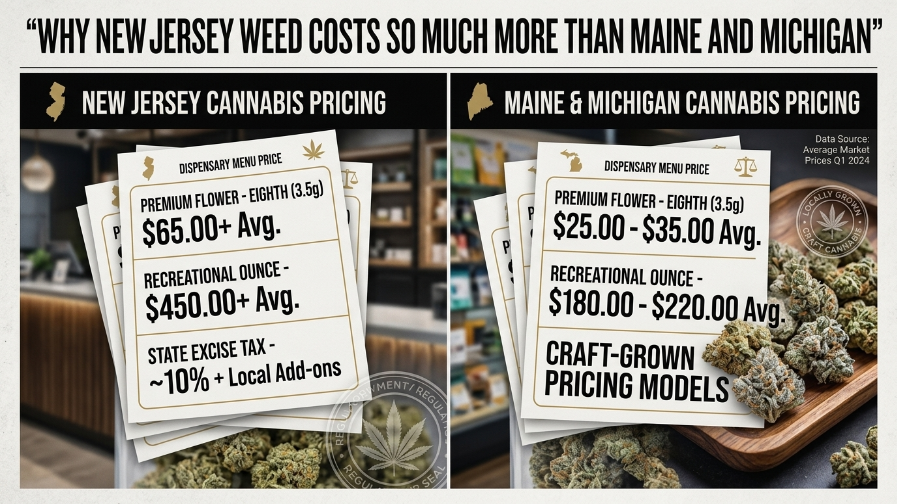
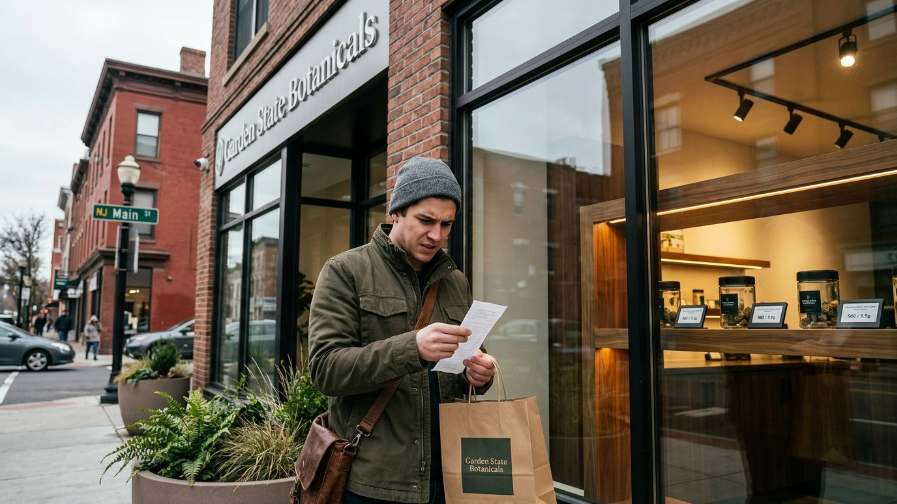
I got so many weed jars in my house, I got closets and drawers filled with empty weed jars that once had a price tag of between $30 and $65 dollars! If you smoke heavily like me, then yea, that shit is going to add up on you. Other neighboring states like Michigan or Maine have legal cannabis prices that are nearly slashed in half—$35 for premium eighths, $230 for premium ounces. These are good prices compared to the strong hold Jersey has on the weed market; I mean, it’s not great!
The high weed prices are a product of a few things going on behind the scenes, and in this article we are going to break down the key reasons why NJ prices are so high and other states are so low.
The Garden State's high prices on cannabis is not accidental, but more like engineered. As much as the regulatory commission would like to blame the high prices on an immature market, that is just not the case! New Jersey has a draconian ban on home growing, leaving most smokers to either pay the high dispensary prices on cannabis, or dip back into the unregulated less safe black market. Mickie Sherrill (Jersey’s newly elected Governor) made promises on the campaign trail to lift the home grow ban, but a year later and nothing has changed. It seems that New Jersey is light years behind the other more mature states that have a better system in place for their legal cannabis market, such as Maine or Michigan.
The Macroeconomic Illusion: We’re Being Played
Let's keep it a buck. When you start googling "why is NJ weed so expensive," you'll usually find corporate PR statements talking about "supply chain infancy" or "high operational costs." That’s a polite way of saying they’ve rigged the game so they can charge whatever they want. New Jersey cannabis prices aren't a mistake—they are the direct, mathematical result of a state-sponsored monopoly designed to squeeze the East Coast consumer.
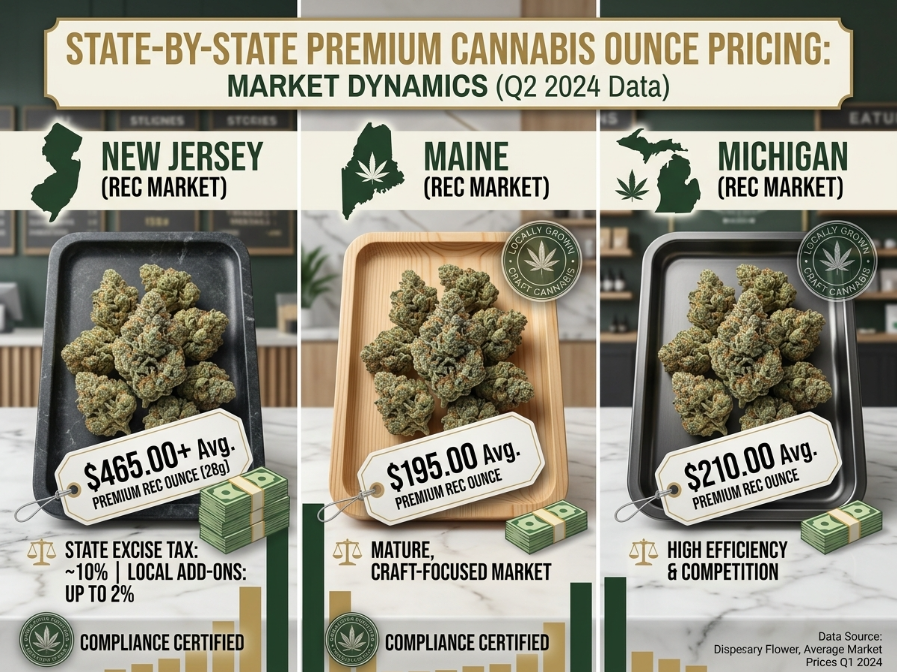
The legal cannabis market across the United States is basically a tale of two realities. If you live in a Midwestern state like Michigan, you’re enjoying access to top-shelf flower for well under $100 an ounce. Up in Maine, their decentralized medical caregiver market routinely pumps out true craft-quality ounces for under $200. But for us in the Garden State? We’re stuck paying an average of $269 per ounce for standard, mid-tier flower. If you want premium products, you’re regularly looking at a laughable $400 to $500 an ounce.
The state loves to brag that the adult-use cannabis market officially surpassed $1 billion in sales in 2024, pacing toward $1.16 billion in 2025. Sounds like a booming success, right? Wrong. The headline revenue numbers hide a massive failure.
Biological demand for weed is relatively fixed. Data shows about 18% of the adult population consumes cannabis regularly (roughly a gram a day). With over 7.15 million adults in NJ, the baseline demand is roughly 470 million grams a year. But at the current retail average of $8.09 per gram, that billion dollars in sales only accounts for barely 20% of the total market demand.
So where is the other 80% going? It's flowing directly into the legacy (illicit) market, underground gifting networks, and across state lines to New York or Massachusetts. To capture that remaining 80%, prices need to compress down toward the $5-per-gram commodity threshold. But the suits in Trenton have built a regulatory wall to make sure that never happens.
The Supply Chain Stranglehold: 158 Towns and a Nightmare Buildout
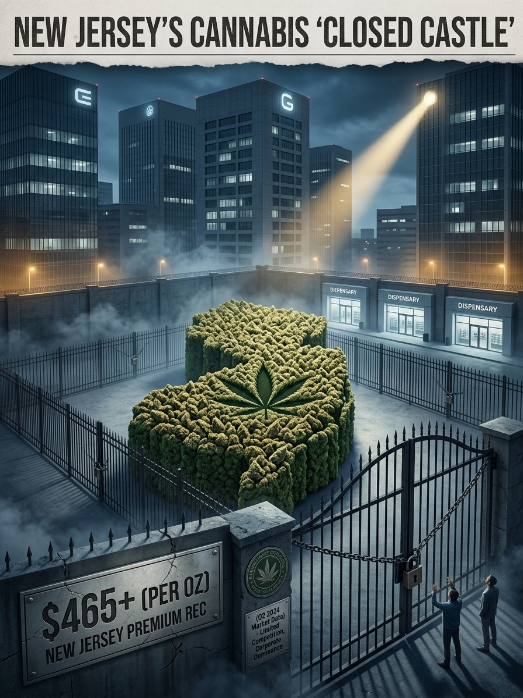
The biggest driver of insane weed prices in New Jersey is artificial scarcity. You can’t have cheap weed if nobody is allowed to grow it.
By late 2025, the NJ Cannabis Regulatory Commission (NJ-CRC) had handed out 2,435 cannabis licenses. Sounds like a lot, right? But here's the catch: only 397 of those businesses were actually operational. That means 84% of the licensed market is trapped in administrative hell.
The bottleneck is worst where it hurts the most: cultivation. Only 8% to 11% of awarded cultivation licenses have managed to turn the lights on. If you want to open a commercial grow facility in Jersey, you need massive institutional money—usually between $2 million and $8 million just to cover the real estate (10,000 to 50,000 square feet), architectural design, HVAC engineering, and municipal permitting. And even if you have the cash, it takes 16 to 24 months to complete the buildout before a single seed touches the dirt.
And then there's the municipal opt-out problem. Out of New Jersey's 564 municipalities, a staggering 63.5% (358 towns) completely banned cannabis businesses. Only 158 towns allow retail, and even fewer allow large-scale cultivation. So what happens? You have thousands of conditional license holders fighting like dogs over commercial real estate in just 158 "green zones." Property values skyrocket, lease rates go through the roof, and the operators pass those inflated overhead costs straight down to you at the cash register.
The Micro-License Myth and the Corporate Stronghold
In an attempt to look like they cared about the little guy, regulators created "micro-licenses." These were supposed to be the cheap entry point for local entrepreneurs—only a $100 application fee and a $1,000 annual fee.
But it was a trap. Micro-businesses are capped at 10 employees and 2,500 square feet. Worse, they have to compete for the exact same hyper-inflated commercial real estate in those 158 opted-in towns against multi-million-dollar corporate conglomerates. Without massive backing, local legacy growers are routinely outbid, leaving hundreds of these equity-focused licenses stalled in the "conditional" phase forever.
This structural barrier heavily favors the Multi-State Operators (MSOs). As of 2026, the top 10 brands in New Jersey account for more than 30% of all units sold. We're talking massive corporate entities like Ascend Wellness (Ozone), Green Thumb Industries (Rythm), TerrAscend (Kind Tree), and Verano (Essence).
Because they have an oligopoly, product quality tanks. Independent retailers struggle to capture market share against the sheer scale of MSO production. MSOs care about two things: high-THC yield and turning crops fast. Ask any legacy smoker on the East Coast and they'll tell you that corporate cultivators "tumble" their flower. They mechanically strip the valuable kief and trichomes off the buds to make high-margin concentrates and infused pre-rolls. What you're left with in the jar is dry, stripped, flavorless bud that they have the audacity to sell for $65 an eighth.
Bill S4847: Fortifying the Castle
If you want to know how deep the corporate capture goes, you need to understand bill S4847 cannabis legislation. Passed in early 2026, this bill was framed to the public as a standard regulatory update for the Cannabis Regulatory Commission. In reality, it was a massive power grab.
Before S4847, retail operators were restricted to a single Class 5 Cannabis Retailer license to prevent monopolization. S4847 blew that cap wide open, allowing a Class 5 license holder to open up to two additional "satellite" locations. Crucially, these satellites skip the heavily backlogged retail application pipeline. This allows well-funded MSOs to rapidly scale their footprint while independent locals wait years for municipal approval.
But S4847 didn't just clear the runway for corporate expansion; it actively militarized the state against the competition. The bill directed the Division of State Police to launch a coordinated enforcement program targeting unlicensed legacy sellers. Unlicensed spots can now be declared public nuisances, leading to immediate closures, asset forfeiture, and civil penalties of $10,000 a day. They are expanding the corporate retail cap while using the cops to crush the gray market, effectively corralling consumers into an overpriced ecosystem by eliminating the competitive pricing pressure.
The Felony Plant: NJ Home Grow Laws 2026
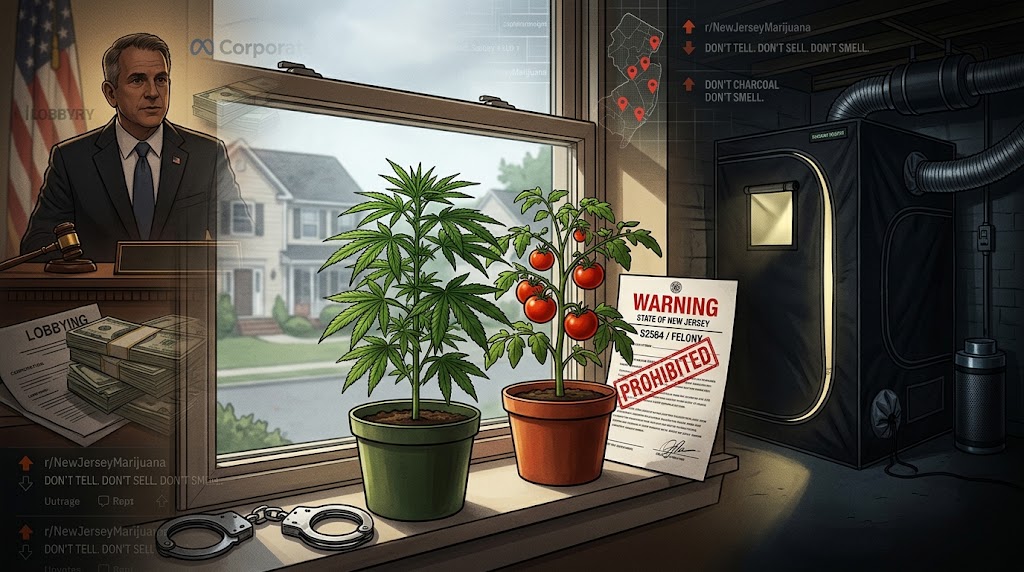
Nothing highlights the absurdity of New Jersey cannabis prices quite like the state's total ban on home cultivation. If you search for NJ home grow laws 2026, you’ll hit a brick wall of hypocrisy. New Jersey remains the *only* major legal market in the nation that throws its citizens in a cage for growing their own weed.
Under N.J.S.2C:35-4, keeping a premises to grow even a *single* cannabis plant is a felony. It's punishable by up to five years in prison and a fine of $25,000. State law enforcement still uses SWAT raids based on minor tips to bust hobbyist growers. This legislation literally criminalizes agricultural self-sufficiency to force every single consumer through the toll gates of a licensed dispensary.
The human cost of this is staggering, especially for the state's 51,776 registered medical patients. Treating chronic illness with dispensary weed is a rich man's game, often costing upwards of $1,000 a month. Furthermore, medical patients don't just need high THC; they need specific ratios, savory terpenes, and minor cannabinoids that corporate growers refuse to cultivate because they take too long to flower and yield less weight.
Advocacy groups have fought tooth and nail for bills like S1985, which would allow adults to grow six plants and medical patients to grow ten. Yet, political powerhouses—specifically Senate President Nicholas Scutari—refuse to even post the bills for a hearing. Critics rightly point out that Scutari is protecting the profitability of the MSOs that heavily lobby Trenton. Denying us the right to grow guarantees a captive consumer base.
The Reality Check: State-by-State Pricing and Taxes (2026)
| State | Market Structure | Average Top-Shelf Ounce | Cultivation / Wholesale Tax Burden |
|---|---|---|---|
| New Jersey | Corporate Oligopoly, Severe Zoning Limits, No Home Grow | $400 - $500+ | $2.50/oz SEEF + Pyramiding Local Transfer Taxes |
| Michigan | Uncapped Open Licensing, Massive Oversupply | < $100 | Punitive 24% Excise Tax (Absorbed by Oversupply) |
| Maine | Decentralized Caregiver Economy (1,300+ small operators) | < $200 | Heavy Weight-Based Tax (Absorbed by Low Overhead) |
The Michigan Model: Oversupply and Price Compression
To truly grasp how bad we have it, look at the Midwest. The contrast in NJ vs Michigan dispensary prices is honestly offensive. Michigan adopted a radically different philosophy: an uncapped, open-licensing system that let free market forces dictate supply and demand, rather than municipal zoning boards.
The result? Extreme price compression. By early 2026, the average retail price for an ounce of flower in Michigan plummeted to around $59.85. That's less than $3.80 a gram. Michigan currently has over 1,000 cultivation licenses, creating an inventory surplus so massive that dispensaries are forced into hyper-competition just to survive. They stack promos, cut prices, and actually have to care about quality. A standard 1-gram 510 distillate vape cart that runs you over $115 in Jersey? You can snag it in Michigan for under $9. Michigan weed prices prove what happens when you don't rig the game.
Even when Michigan enacted a brutal 24% wholesale excise tax in January 2026 (the Comprehensive Road Funding Tax Act), retail prices didn't explode. The massive existing oversupply acted as a shield, forcing operators to compress their own profit margins rather than passing the 24% spike onto the consumer.
The Maine Model: Power to the Caregivers
You don't need a massive corporate oversupply to fix prices. Just look north. Maine cannabis prices are some of the fairest in the country, and they achieve it through a decentralized, grassroots caregiver system.
Maine's $513 million market is dominated by local caregivers, not multi-state conglomerates. Out of all their cannabis licensees, roughly three-quarters are registered medical caregivers. The barrier to entry is beautifully low. For a $31 background check and a $300 registration fee per patient, a cultivating caregiver in Maine can legally serve five patients, utilizing up to a 500-square-foot plant canopy. They can operate retail storefronts, make concentrates, and engage in wholesale.
This floods Maine with incredible, craft-quality cannabis cultivated by thousands of small-scale farmers. Because overhead is low and competition is hyper-local, quality stays premium while prices sit comfortably around $6.62 to $8.60 per gram. The corporate MSO model literally cannot survive in an environment where independent legacy operators are legally protected to grow fire weed at an amortized indoor cost of $60 an ounce. In fact, in 2024, cannabis giant Curaleaf sold off its final adult-use storefront in Maine and fled the state because they couldn't compete against the locals.
The Consumer Revolt: Reddit, Road Trips, and the Loophole
East Coast consumers aren't stupid. We know we're being fleeced, and the backlash is growing. Go on the r/newjersey subreddit and you'll see a massive consumer revolt against the licensed dispensary system. Users routinely expose MSO brands for selling "middies" full of stems under premium branding.
Because of these ridiculous weed prices in New Jersey, buyers are taking matters into their own hands. Interstate arbitrage—border hopping—is the new norm. Jersey residents are regularly driving to New York’s gray market or up to Massachusetts to buy in bulk at near-commodity pricing.
Then there's the THCA loophole. Thanks to the 2018 Federal Farm Bill, cultivators across the country are legally shipping high-THCA "hemp" flower right to our doorsteps through the USPS. When you smoke or vape THCA, it decarboxylates and converts directly into standard Delta-9 THC. It is biologically indistinguishable from dispensary weed, but it bypasses the entire NJ regulatory firewall and sells for a fraction of the price.
The Bottom Line
The exorbitant price of New Jersey cannabis is the engineered result of a state-sponsored oligopoly. By choking the supply chain with municipal opt-outs, expanding corporate retail caps while raiding the legacy market, and threatening citizens with five years in prison for planting a seed in their own backyard, the state has completely insulated corporate operators from the free market.
Until Trenton legalizes home cultivation and removes the municipal bottlenecks, we are going to keep paying the "MSO markup." As consumers, our only power is our wallet. Stay educated, track the pricing trends, support the rare independent micro-dispensaries fighting the good fight, and hold these newly elected politicians to their promises. We shouldn't have to choose between going broke at the dispensary or committing a felony in our basements.