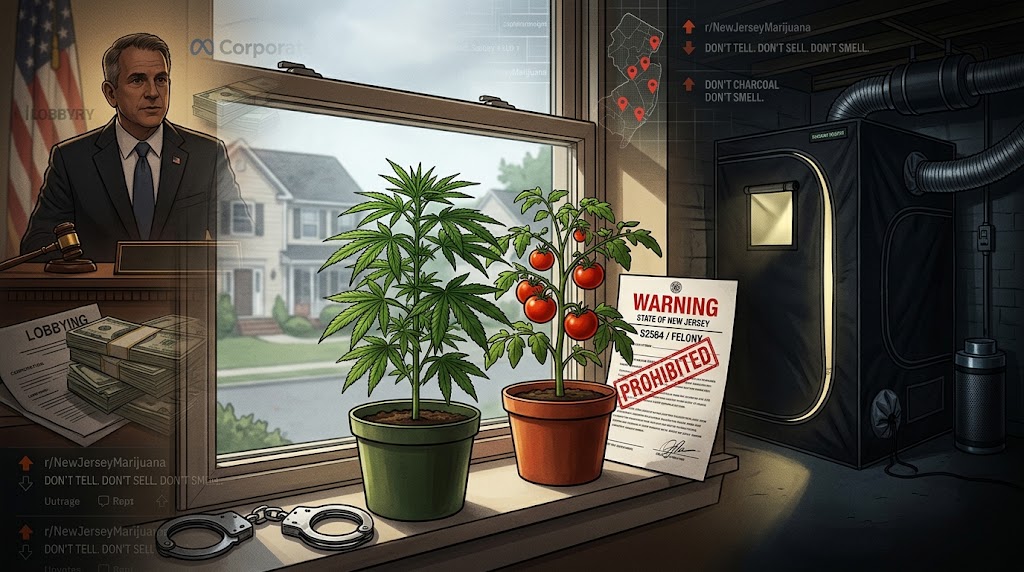


The Garden State Felony: Why Growing One Cannabis Plant in New Jersey Can Still Land You Five Years in Prison
Billion-Dollar Markets, Corporate Monopolies, and the Broken Promises of Trenton
With legal dispensaries making billions, why are New Jersey residents still facing hard time for planting a single seed in their own backyards? We're breaking down the politics, the money, and the absolute BS keeping the home grow ban alive.
It’s been five years since cannabis was legalized in New Jersey, and we are still dealing with a draconian ban on home growing.
It is sad to see that the state's greed supersedes the well-being of the residents in NJ. God forbid a New Jerseyan doesn’t pay taxes on their weed. I have lived in Jersey my whole life, and I have also been to prison for cannabis-related felonies. I personally know three different people that were sent to prison for growing cannabis since legalization. I mean, this is becoming ridiculous!
Mickie Sherrill promised us five plants on the campaign trail, only to not deliver with over 7 months in office. These politicians only have their interests in mind. Knowing that there are thousands of medical patients struggling, not being able to afford cannabis, not having access to rare breeds and phenotypes... sometimes you need to leave money aside and do what’s right for the people you govern!
Unfortunately, this is not what’s happening in Jersey right now, and the climate on home growing doesn’t seem to be changing. With prices in Jersey staying high, cannabis smokers are getting tired of the BS. In this article, we are going to break down exactly where we are on this home grow ban, who is benefiting, and why the state would rather make you a felon than let you grow your own medicine.

The Contradiction Nobody Can Ignore
The State of New Jersey stands at the intersection of a profound legislative and moral paradox. By the close of 2025, the state’s regulated cannabis market had generated an estimated $1.38 billion in retail sales. That’s a 33 percent year-over-year expansion, securing New Jersey’s position as the tenth-largest cannabis market in the United States. State officials and the Cannabis Regulatory Commission (CRC) are popping champagne over this economic windfall. The market supports nearly 11,800 full-time jobs across roughly 238 licensed dispensaries, injecting an anticipated $106 million in tax revenues into the state budget.
To the casual observer, the Garden State has fully embraced the end of cannabis prohibition. They champion social equity and modern regulatory frameworks on camera. But beneath the veneer of this corporate success story lies a draconian reality that exposes the severe limits of New Jersey’s decriminalization.
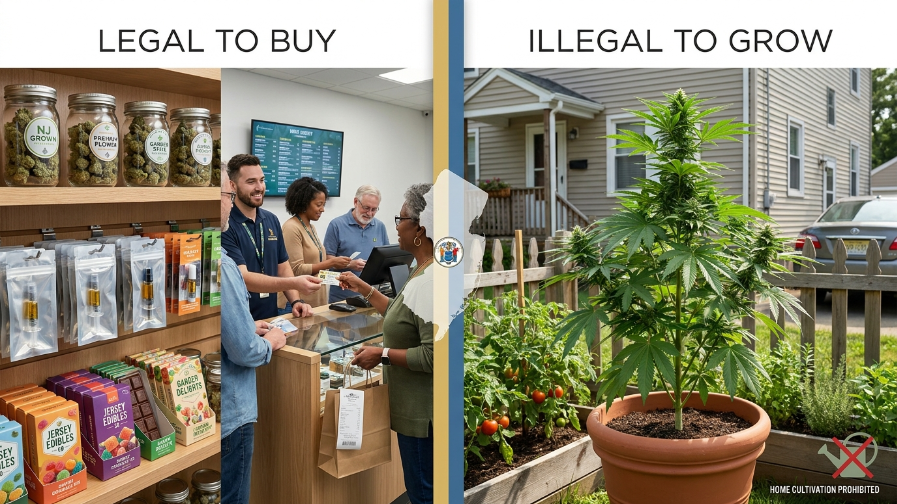
Here is the contradiction that nobody can ignore: You can legally walk into a dispensary over the age of twenty-one, purchase up to one ounce of premium cannabis flower, put it in the trunk of your car, and drive home without a single worry. You can possess up to six ounces without a criminal penalty. But if you purchase a legal, ungerminated cannabis seed and place it into a pot of soil in your own basement? You are instantly transformed into a felon.
New Jersey shares an exclusive, highly restrictive status with only three other legalization states—Delaware, Illinois, and Washington—that prohibit recreational home cultivation entirely. But Jersey is even worse because, unlike Illinois and Washington, our state also explicitly forbids registered medical patients from growing their own life-saving medicine.
Anatomy of a Felony: What Happens If You Grow One Plant?
To understand the severity of New Jersey’s home grow prohibition, we have to look at the state’s archaic criminal statutes—specifically, N.J.S.A. 2C:35-5. This is the law that governs the manufacturing, distributing, or dispensing of controlled dangerous substances.
Under New Jersey law, there is absolutely zero distinction between "personal cultivation for private use" and "manufacturing for illicit distribution." The act of growing a cannabis plant is legally synonymous with operating a drug manufacturing facility. When lawmakers passed the CREAMM Act to legalize possession, they left these punitive statutes totally intact.
The criminal exposure escalates rapidly based on plant count, regardless of whether they are tiny ungerminated seedlings or massive mature plants. Let's break down the actual penalties you face today in New Jersey:
Table 1: The Tiered Penalties of Cultivation in NJ
| Plant Count | Criminal Classification | Presumptive Incarceration | Maximum Fine |
|---|---|---|---|
| 1 to 9 Plants | Third-Degree Crime | 3 to 5 Years | $25,000 |
| 10 to 49 Plants | Second-Degree Crime | 5 to 10 Years | $150,000 |
| 50 or More Plants | First-Degree Crime | 10 to 20 Years (Mandatory Mins) | $300,000 |
If you get caught growing a single plant to save money or ensure a pesticide-free product, you risk up to five years in state prison. The collateral consequences are devastating too. A conviction triggers mandatory suspension of driving privileges for six months to two years. It strips you of public housing eligibility, creates grounds for eviction, and ruins your employment prospects.
Adults in NJ can brew up to 200 gallons of beer or wine annually for personal use without facing criminal charges, facility inspections, or taxation. The ban on weed is not about public safety; it's about the deliberate, aggressive protection of a nascent, heavily taxed commercial industry.
The Street Vibe: Cultural Dissonance and Community Outrage
The dissonance between New Jersey’s highly corporatized legal market and its carceral approach to home cultivation has generated immense friction among consumers. You only have to look at online communities like Reddit (r/newjersey and r/NewJerseyMarijuana) to see how angry people are. The legal market is routinely blasted for high costs, inconsistent quality, and corporate monopolization.
Legacy consumers frequently report purchasing overpriced, overly dry, and occasionally moldy products from licensed Multi-State Operators (MSOs). To pass the state's stringent microbial testing requirements, commercial cultivators often rely on irradiation or ozone treatment to sterilize their massive harvests. Connoisseurs argue this degrades the delicate terpene profiles. This is why investigations like the Safe Leaf report on NJ's cannabis supply are making waves—they confirm what the streets already know: corporate weed often cuts corners.
Furthermore, hobbyist growers advocate for the right to "pheno-hunt." They call the decentralized hobbyist community a "genetic ark." In agriculture, monocropping leads to genetic bottlenecks, making crops susceptible to pathogens. Finding the perfect phenotype requires germinating dozens of seeds. Under current New Jersey law, germinating twelve seeds instantly triggers a second-degree felony, carrying a presumptive five-to-ten-year prison sentence. The state is effectively handing a total monopoly over plant genetics to a handful of heavily capitalized corporations.
Why Patients Are Frustrated: Extorted for Corporate Profits
If the prohibition of home cultivation is an ideological affront to recreational consumers, it is a catastrophic financial burden for medical cannabis patients. The economics of the program function as a regressive tax on the sick, forcing patients to choose between physical suffering and financial ruin.
Despite recent price compressions, New Jersey remains one of the most expensive states for cannabis. The average retail price for an ounce of flower hovers around $290 (roughly $10.36 per gram). If you look at the most popular pre-rolls and strains on dispensary shelves, premium products like live rosin command astronomical prices of $70 to $100 per gram.
Because cannabis remains a Schedule I controlled substance federally, health insurance absolutely does not cover it. Let's look at the math for a medical patient suffering from chronic pain, multiple sclerosis, or cancer:
Table 2: The Insane Cost of Being a Patient in NJ
| Monthly Cannabis Requirement | Average Cost per Ounce | Estimated Monthly Cost | Estimated Annual Cost |
|---|---|---|---|
| 1 Ounce (Occasional/Mild) | $290 | $290 | $3,480 |
| 2 Ounces (Moderate) | $290 | $580 | $6,960 |
| 4 Ounces (Heavy/Severe) | $290 | $1,160 | $13,920 |
Compare this to the economics of home cultivation. Setting up a professional-grade indoor grow tent—complete with LED lighting, carbon filtration, and automated sensors—costs between $850 and $1,800. Ongoing operational costs average $50 to $150 per month. A standard 4x4 foot grow tent can sustainably yield over 44 ounces annually. For a medical patient consuming four ounces a month, growing their own medicine reduces their annual expenditure from nearly $14,000 at a dispensary down to approximately $1,680. The ROI is realized in roughly four months.
By enforcing a felony prohibition, the State of New Jersey effectively mandates that chronically ill residents transfer their wealth to corporate cannabis entities.
Follow The Money: MSOs and the Scutari Bottleneck
The preservation of New Jersey's home grow ban isn't a legislative accident; it’s the result of deliberate, sustained lobbying by well-capitalized corporate interests. Multi-State Operators (MSOs) like Curaleaf, TerrAscend, and Verano dominate the Garden State. They view home cultivation as a direct, existential threat to their profit margins.
Their goal is to establish localized monopolies. When consumers can produce a superior product at a fraction of the cost, the artificial scarcity required to maintain $60 eighths shatters. To prevent market equalization, MSOs heavily lobby state legislatures. This gets even worse when you look at New Jersey's cannabis deserts, where local towns ban dispensaries, forcing residents to drive miles just to be overcharged, with no legal option to grow at home.
In Trenton, this corporate capture points squarely at Senate President Nicholas Scutari. Scutari, instrumental in drafting the legalization framework, is universally recognized as the primary legislative roadblock preventing home cultivation. He blocks bills from advancing out of committee, arguing the commercial industry needs "time to mature." The New Jersey Home Grow Coalition has explicitly rejected this, stating that home cultivation will not negatively impact a billion-dollar legal industry.
Scutari’s maneuvers go beyond blocking; he actively tries to tighten the grip. He previously introduced legislation (S3171) seeking to strictly recriminalize purchasing cannabis from unlicensed sources. And let's not forget the prohibitionist organizations like Smart Approaches to Marijuana (SAM), who spread fear about home grows causing neighborhood disturbances, conveniently backing up the MSO's financial interests.

Arrests and the Illusion of Decriminalization
Lawmakers heralded the CREAMM Act as the end of a racially biased, draconian era of enforcement. It's true that overall possession arrests plummeted over 98%. But the continued classification of cultivation as an indictable offense preserves a dangerous weapon for law enforcement.
Growing any amount without a license triggers minimum third-degree charges. Recent enforcement actions underscore the dire consequences; in one widely publicized case, a woman received a six-year prison sentence for cultivating just eleven cannabis plants in her home. These laws specifically endanger marginalized communities. Low-income patients residing in "cannabis deserts" often choose to cultivate a few plants out of financial desperation, placing themselves directly in the crosshairs of the carceral machinery of the War on Drugs.
The Bills That Never Seem To Move
Despite the Scutari blockade, grassroots organizations and sympathetic lawmakers continue to introduce legislation. Currently, there are three prominent bills fighting for air in Trenton:
- S2564 and A4576 (Comprehensive Adult-Use): Introduced by Senators Vin Gopal and Troy Singleton. This bill allows adults 21+ to grow up to six plants, and medical patients up to ten plants. It includes a strict household cap of twelve plants to prevent illicit commercial operations, officially decriminalizing home cultivation.
- S1758 (Medical-Only Compromise): Recognizing political opposition, this narrower bill allows registered medical patients to grow a maximum of four mature and four immature plants, and legally protects designated caregivers assisting severely disabled patients.
The New Jersey Home Grow Coalition is also pushing an evolved conversation: moving away from arbitrary plant counts and toward a canopy area limit (e.g., a 100-square-foot grow area). This gives breeders flexibility to pheno-hunt while naturally capping potential yields, aligning with standard agricultural practices rather than invasive police plant-counting.
A National Outlier: How Other Legal States Handle Home Grow
To grasp the absurdity of New Jersey's stance, look at the rest of the country. Out of the 24 states that have legalized recreational cannabis, 20 of them permit adults to cultivate cannabis at home. New Jersey sits in an isolated minority.
Table 3: How NJ Compares to Other Legal States
| State | Recreational Legal? | Rec. Home Grow? | Medical Home Grow? | Max Plants allowed |
|---|---|---|---|---|
| New York | Yes | Yes | Yes | 6 Rec / 6 Med (12 per household) |
| Massachusetts | Yes | Yes | Yes | 6 Rec / 12 Med (12 max per household) |
| Illinois | Yes | No | Yes | 0 Rec / 5 Med |
| Delaware | Yes | No | No | 0 Rec / 0 Med (Felony) |
| New Jersey | Yes | No | No | 0 Rec / 0 Med (Felony) |
Even states that banned recreational home grow, like Illinois and Washington, recognized the moral imperative of allowing medical patients to cultivate their own supply. Delaware and New Jersey remain the only fully legalized states that completely ban the practice for all citizens, subjecting patients to arrest for attempting to grow a therapeutic plant.
The Sherrill Administration: 7 Months of Broken Promises
During the 2025 campaign, Governor Mikie Sherrill explicitly broke with the Murphy/Scutari protectionist stance. She firmly stated her support for legalizing marijuana home cultivation, paired with "common-sense regulations." It sounded like a massive victory for the cannabis community.
Yet here we are, over 7 months into her term in 2026, and she has failed to deliver on that 5-plant promise. While Sherrill has shown a willingness to rapidly modify the state's cannabis infrastructure—such as signing legislation (S3945 / A5051) aimed at closing intoxicating hemp loopholes and allowing dispensaries to bypass local municipal bans—home grow remains untouched. It seems the combined pressure of Scutari's Senate blockade and the MSO lobby is still dictating policy in Trenton, even under a supposedly progressive new governor.
What Happens Next?
New Jersey’s approach to cannabis home cultivation represents a cynical, deeply damaging distortion of the principles of legalization. A legal framework that permits the state to collect a projected $106 million in tax revenue from corporate sales, while simultaneously threatening to imprison a medical patient for five years for growing a single plant, is an act of state-sponsored economic extortion.
The data is unequivocal. The ban harms patients absorbing $14,000 annual expenses. It stifles agricultural innovation, hands plant diversity over to irradiated MSO crops, and weaponizes the criminal justice system against hobbyist gardeners.
The excuses of "market maturation" hold zero validity in a billion-dollar market. Advocates are demanding action on S2564 and A4576. They are demanding Governor Sherrill stand up to Scutari and honor her campaign promises. Until the state legislature dismantles N.J.S.A. 2C:35-5, New Jersey’s cannabis market will remain an exercise in hypocrisy—a system where your "freedom" is strictly defined by the transaction at a corporate cash register.